
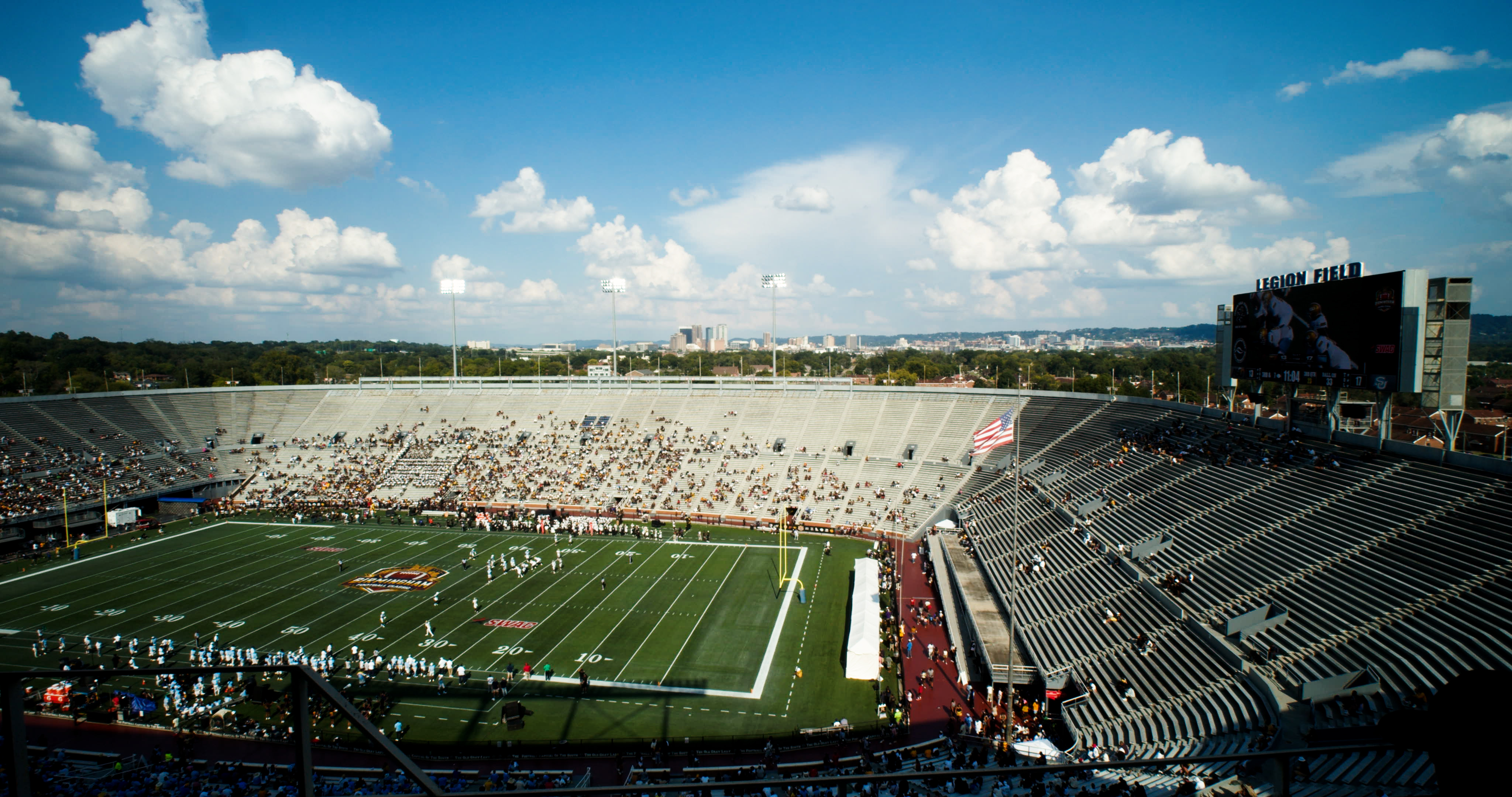

College football is in a very different place than it was 100 years ago. The transfer portal, NIL, and non-leather helmets weren’t even concepts yet. Football was barely becoming the game we know it as today, with the forward pass still working its way into the importance of gameplans. But a stadium was being built that would last through these changes to the sport. A stadium that would host some of the greatest college football games the sport, especially the South, had ever seen. A stadium that would host different leagues, sports, and even appear on the Olympic stage. That stadium is Legion Field. And Legion Field still matters today.

Legion Field began construction in Birmingham, Alabama in 1926 and was opened in 1927 as a venue to be the premiere host of football in the state. The first game played there was a 9-0 victory by Samford (at the time known as Howard College) over Birmingham-Southern College. The stadium grew rapidly over the years, and was most famous for the numerous Alabama Crimson Tide games that it hosted. In the era before college stadiums dwarfed professional stadiums, neutral sites like this were far more common.
The “Old Gray Lady,” as it was known, hosted every single Iron Bowl from 1948-1988, making the yearly pilgrimage to Birmingham tradition between Auburn and Alabama. While Alabama has a slight distance advantage, it didn’t stop caravans of rabid fans from driving across both sides of the state to state their superiority in the center.
Over the decades, Legion Field has also hosted multiple bowl games, the 1996 Olympic Soccer Games, and a number of Birmingham’s spring football teams. From the Birmingham Americans and Vulcans to the modern Birmingham Stallions, Legion Field has been a part of all Birmingham’s major football endeavors. It was also the host of the UAB Blazers from 1991-2020, before Protective Stadium was built.

And it is Protective Stadium that has shifted things away from Legion Field in recent years. It’s in-town as opposed to slightly outside the city. It’s much more modern with its amenities. It hosts the Blazers, the Birmingham Legion, and (up until recently) the Stallions. With the surrounding restaurants and bars, it’s no wonder that concerts and sports have shifted to Protective.
However, Legion Field still belongs in 2026. Yes, one of the chief complaints about Protective is its size and lack of cover from the sun. Yes, Legion Field is larger and arguably even more in the sun’s beam. But the stadium has changed roles from being the perennial event venue. Now, it acts as a piece of living history.
Birmingham is not a stranger to sentimental stadiums. The Birmingham Barons play baseball in Regions Field, yet Rickwood Stadium is still beautifully maintained and used on special occasions. Legion Field acts in much the same way. While it stands empty most of the year, it also hosts one of the biggest football games in Birmingham, the Magic City Classic.

The Magic City Classic is the biggest HBCU football game in Alabama, with the clash between Alabama A&M and Alabama State bringing a longstanding rivalry to the Old Gray Lady every year. The Iron Bowl will stand as Legion Field’s greatest historical rivalry, but this is the modern powerhouse.
The use of Legion Field is expanding as well. To kick off the 2026-27 College Football season, the field hosted the inaugural Birmingham Classic between Alabama State and Southern University.

With all the different Week 0 traditions, why not bring one to Birmingham? Kicking off the new year of college football in one of the country’s most storied stadiums just feels right. It helps that the game was high octane from start to finish as well. Southern jumped out to an early lead, but Alabama State dominated the second half to secure a 30-17 victory. With the bright Alabama sun and the battle of two of college football’s finest bands as well, the Birmingham Classic was a rousing success.
By making Legion Field a place to celebrate the past and present of college football, and host smaller programs for giant showdowns, the stadium that is a part of Birmingham’s heart gets to stay alive. You can’t tell the story of college football without Legion Field, and it deserves its place in the modern day. Not simply as a relic or a ghost of games that were once played there, but as a way to stay connected to the past while embracing the future of the sport. And really, you just can’t beat the view of the Birmingham skyline in the back.
Leave a Reply